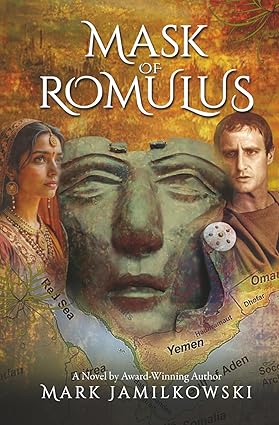
A cinematic epic of empire, prophecy, and the human cost of power.
In this ambitious historical novel, Jamilkowski draws Rome and India into dialogue through power, prophecy, and inner conflict. Rome was born from prophecy. Centuries later, Augustus faces war, treachery, and the burden of rule, guided by the same unseen powers. His meeting with Kamala, an oracle from India, sets in motion a chain of events that will redefine empire and destiny alike.
The world that Jamilkowski creates is an ancient world defined not by isolated empires but by exchange—of ideas, beliefs, and ambition. The novel’s emotional and intellectual center is Augustus, rendered with notable psychological complexity. Jamilkowski resists portraying him as a finished emblem of empire. He depicts him as a man always evolving—shaped by recurring illness, rigorous self-discipline, and an unyielding habit of reflection. His struggles with authority, discipline, and legacy are revealed gradually, shaped by mentorship, military service, and philosophical inquiry. By attending closely to his internal reasoning—his hesitations, calculations, and moral assessments—the novel depicts power as a sustained and isolating duty, not a singular achievement.
Kamala enters the narrative as an expansion rather than a diversion. Her role as an oracle from India introduces a spiritual lens that challenges Roman pragmatism and tempers Augustus’ reliance on discipline and reason. The bond that forms between them is understated and purposeful, defined by recognition instead of passion (and it quietly shapes the novel’s emotional and philosophical core). Through Kamala, the story asks what it means for leaders to truly listen—to gods, to advisors, and to the unease they carry within.
The prose is controlled and purposeful. The battle scenes are effective, matched by dialogue that is sharp and controlled. Its political architecture is layered yet navigable, strengthened by research that quietly sustains the narrative. Across the novel, historical figures are portrayed with credibility and dimension, moving through a world defined equally by philosophy, belief, and warfare. While the book does not seek to overturn the conventions of historical fiction, it distinguishes itself through intellectual ambition and emotional restraint. It treats history as lived experience rather than distant chronicle, asking sustained questions about legitimacy, destiny, and the unseen forces that guide human action. The result is a thoughtful, immersive novel that rewards attentive readers with depth and resonance.
Readers who loved The Mask of Apollo by Mary Renault and Augustus by John Williams will be greatly rewarded.
Treaty Oak Publishers
Pub date November 6, 2025
ISBN 978-1959127482
Price $44.99 (USD) Hardcover, $20 Paperback, $4.99 Kindle edition

